Health & Fitness
Everyone Should Know the Basics of CPR
Learning how to use an AED isn't a bad idea either. You never know when you'll be called on to help save a life.
Code Blue 3B rm:317... Code Blue 3B rm:317... Code Blue 3B rm:317...
If you work in a hospital, you hear this kind of thing a lot. It's an emergency call alerting specialized hospital staff that they need to get to rm 317 quickly.
All of the doctors, nurses & therapists assembling in rm 317 know what they are doing or they wouldn't be there.
Find out what's happening in Lakewoodwith free, real-time updates from Patch.
Every one of these professionals spends hours upon hours every year keeping up advanced certifications to be able to function as part of the in-house 'Code Team'.
We all know what these people do and why they do it, so let's talk for a moment about the millions that don't do it. Who are they? They are you... the 'lay rescuer' with NO training at all.
Find out what's happening in Lakewoodwith free, real-time updates from Patch.
Professionals responding to emergency situations denote a very small percentage of the population in any area. The real target for training in CPR/AED and First Aid basics is you; that portion of the population that doesn't do it everyday, has maybe never seen it or been exposed to a real 'emergency' in their life!
Everyone should know the basics of CPR and how to use a simple AED correctly, efficiently and quickly...everyone.
When a person collapses from a catastrophic event time is of the essence. You basically have less than 5 minutes to start adequately perfusing the brain before cell death begins to occur, irreversible cell death, after which that person will probably never recover fully even if the heart is restarted minutes later.
A 'street' AED is easy to use.
Really, it's simple... even with NO training at all.
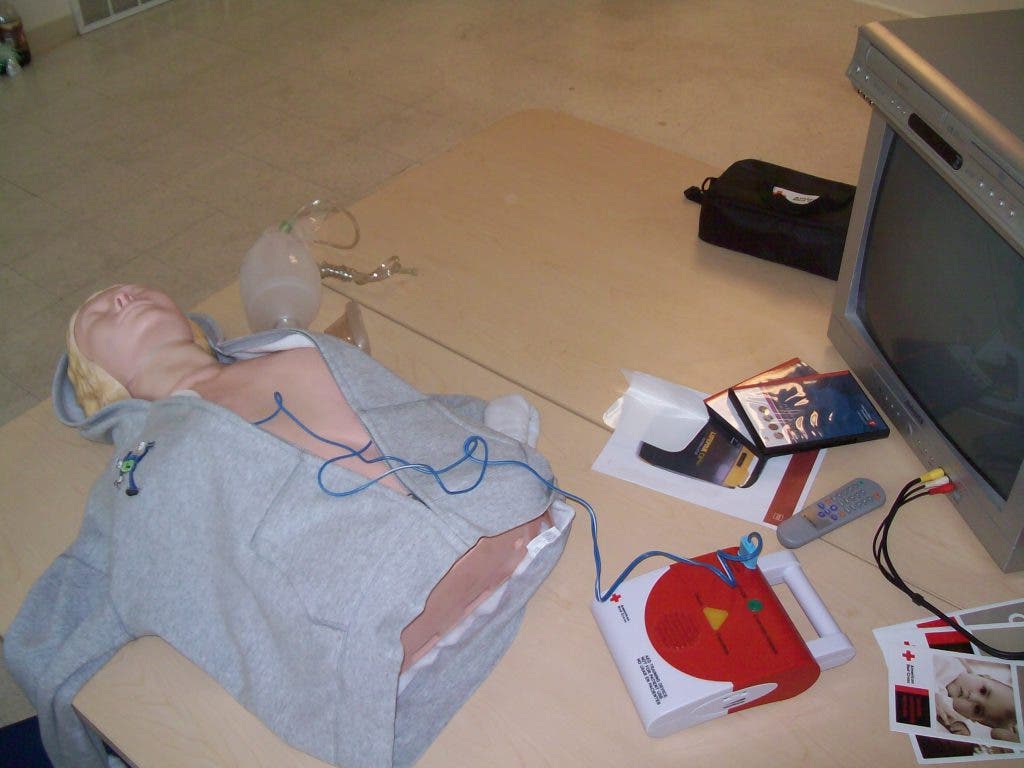
To prove it we tested a bunch of 3rd graders. Do you know that the average 3rd grader can successfully use a simple AED by following the instructions on the inside cover of the AED and looking at the pictures that are there?
It's true. If you can see & hear, then you can use an AED, the first time you pull it off the wall even if you've never, ever seen one before.
The trick is... to PULL IT OFF THE WALL!
Many times the AED is never even taken from its mount till an emergency team gets there or a trained medical professional happens on the scene. Learning how to do CPR and use an AED is critical to the survival of victims everywhere.
Now, doesn't that make you want to get some training yourself?
Learn how to save a life.
Joni Nowak RN/CCRN; American Heart Association:Instructor

