Health & Fitness
Drivers Dodge Potholes. The Government Dodges Liability.
The government rarely pays for damage caused by bad pavement.
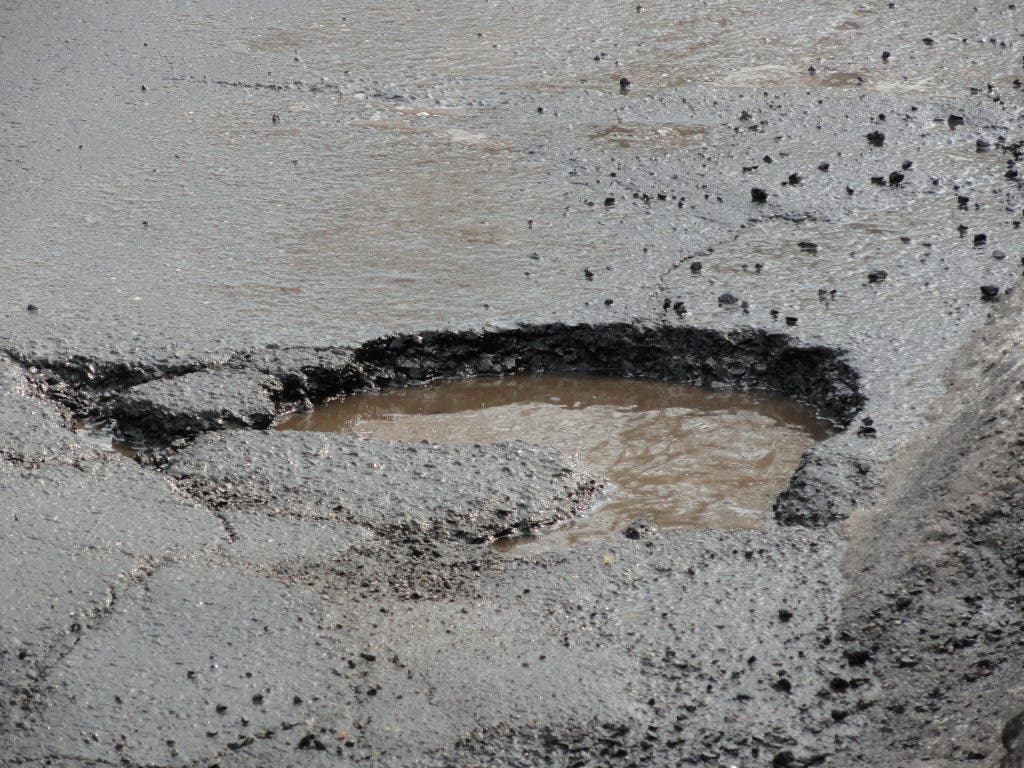
I have an early-springtime ritual that I perform several days each week. I call it Running the Potholes. The route to my office includes a short street with concrete pavement, and potholes open up like crocuses this time of year.
Every seam in the pavement is lined with a string of cracks, depressions and gaping chasms. Hitting one can be a bone-jarring, teeth-rattling experience. Trying to avoid the hazards makes me feel like Han Solo piloting the Millennium Falcon through as asteroid field. (OK, so it’s not all bad.)
However, hitting a large pothole can do serious damage to your car and can even cause an accident. When this happens, is the city or the county liable for failing to maintain the road? As with most legal questions, the answer is, “it depends.”
Find out what's happening in Lakewoodwith free, real-time updates from Patch.
The State of Ohio decided long ago that it generally is not responsible for anything that it does or fails to do. The Ohio Revised Code says that the State and all of its political subdivisions are not liable for damage to people or property caused in connection with the performance of a governmental function.
There are a few exceptions to this rule, though. The government can be sued for injuries or damages resulting from a “negligent failure to keep public roads in repair and other negligent failure to remove obstructions from public roads.”
Find out what's happening in Lakewoodwith free, real-time updates from Patch.
OK, so you hit a pothole, swerve and hit a tree. The city or the county is liable for failing to repair the road, right? Maybe. Remember, the government is liable for negligent failure to keep public roads in repair. In order to prove the government was negligent, you have to show that it knew or should have known about the problem, and that it failed to correct it within a reasonable time.
Obviously, if someone complained to the government about the pothole (hopefully in writing), it will be easy to prove that the government knew about the problem. If the entire street is a minefield of potholes, I would argue that a complaint about one pothole should put the government on notice regarding the entire street.
But the city or the county does not have to have actual notice; it can also have something called “constructive notice.” If a large pothole existed for weeks on a street that city vehicles use every day, a city cannot claim that it did not know about the problem. Somebody in the city’s employ should have brought the issue to the city’s attention.
Unfortunately, if you are injured or your car is damaged due to a pothole, you may not know whether the government can be sued until you have done a lot of investigation into how long the pothole existed, who knew about it and whether anyone complained before your accident.
Even if you can show that the city or the county had notice, you can almost bet that your claim will be denied on the grounds that you were at fault for hitting such an open and obvious hazard. (I mean, you just admitted it was a HUGE freakin’ pothole.) That’s not to say that you can’t win such a claim, but the damage has to be pretty severe to make the effort worthwhile.
If you would like to help protect yourself and other drivers, take a moment to put your city or county on notice when you see a dangerous road condition. A simple email can go a long way toward getting the problem fixed. It can also go a long way toward holding the government responsible if its failure to act causes an accident.
Have a question or a suggestion for a topic? Email dspirgen@SpirgenLawFirm.com.
Patch posts are general discussions and should not be used as advice on any specific legal matter. If you need legal advice on a particular situation, please consult an attorney.

